Free Bouldering Campus Board Rung Spacing Calculator— gemini-3.0-flash
gemini-3.0-flashUse this free tool to calculate optimal bouldering campus board rung spacing. Improve your climbing training with precise reach distance measurements today.
AI Generation Prompt
Bouldering Campus Board Rung Spacing Calculator
Overview
This single-file application is a specialized utility designed for climbers to calculate the ideal vertical distance between rungs on a campus board based on personal anthropometric data. It transforms raw physical measurements into actionable, safe, and effective training dimensions.
Detailed Feature List
- Anthropometric Input Engine: Captures user height, arm span, and current climbing grade.
- Ape Index Analysis: Automatically calculates the user's Ape Index and adjusts recommendations accordingly.
- Adaptive Spacing Logic: Calculates suggested spacing for 'Basic,' 'Intermediate,' and 'Advanced' training intensities.
- Interactive Visualizer: A responsive SVG visualizer that dynamically renders a campus board preview based on the calculated values.
- Constraint Awareness: Includes a toggle to switch between metric (cm) and imperial (in) units.
- Print-Friendly Mode: A dedicated CSS print stylesheet that cleans the UI into a simple table/list format for easy workshop reference.
UI Layout
- Header: Clean, minimalist title with an icon and a brief subtitle describing the tool's utility.
- Main Tool Area (Two-Column Grid):
- Left Column (Inputs): Input fields for height, arm span, and preferred difficulty level. Includes clear, labeled ranges and helper text.
- Right Column (Output): Real-time calculation results displayed in large, readable typography, accompanied by the SVG board visualizer.
- Visualizer: An interactive SVG strip showing the spacing ratios. Hovering over a gap shows the specific distance.
Color Palette (Light Mode Only)
- Background:
#FFFFFF(White) for the main container,#F1F5F9(Slate 100) for the page background to create depth. - Primary Accent:
#2563EB(Blue 600) used for calculation highlights and the primary button. - Text:
#1E293B(Slate 800) for primary text,#64748B(Slate 500) for labels/helper text. - Status/Highlights:
#059669(Emerald 600) for success states,#DC2626(Red 600) for safety warnings.
Animations & Transitions
- Smooth Re-calculation: When input values change, the SVG visualizer updates using CSS transitions (ease-in-out) to smoothly slide rungs to their new positions.
- Input Focus: Smooth shadow/border color transitions when a user selects an input field.
- Hover Effects: Soft scaling on interaction buttons.
Developer Directives
- Strict Single File: All CSS, HTML, and JS must reside in one
.htmlfile. - No Persistence: Do not use
localStorageorsessionStorage. All state must be managed via JavaScript object variables. - Sandboxed Compatibility: Ensure no reliance on external APIs or tracking scripts. All dependencies (e.g., FontAwesome, Tailwind) should be loaded via CDN links. Avoid all
alert(),confirm(), orprompt()calls; create custom modal components if needed. - Responsive Design: Use a mobile-first approach. At narrow widths, the two-column grid should stack vertically. Ensure font sizes remain legible on mobile devices.
Spread the word
gemini-3.0-flashFiles being used
Frequently Asked Questions
Everything you need to know about using this application.
Why is proper campus board rung spacing important?
Correct rung spacing is fundamental to safe and effective campus board training. If the rungs are spaced too far apart, you risk overextending your joints, which significantly increases the likelihood of pulley injuries and tendonitis. Conversely, spacing that is too close fails to challenge your explosive contact strength and prevents you from developing the necessary recruitment for advanced climbing moves. By calibrating your board to your specific anthropometric measurements, you ensure that every repetition is performed with optimal biomechanics. This precision allows you to progress safely through your training cycles while maximizing the muscular stimulus required to improve your overall climbing power.
How does the calculation tool determine the optimal spacing?
This calculator uses anthropometric ratios based on your reach, arm span, and height to determine the recommended distance between rungs. It applies standard athletic training principles used in climbing performance coaching to suggest a baseline spacing that accounts for your 'Ape Index'—the ratio of your arm span to your standing height. Higher ape indices often require slightly wider spacing to maintain proper tension. While this tool provides a scientifically grounded starting point, we always recommend adjusting based on your current physical condition and injury history. The objective is to find a spacing that allows for fluid, explosive movement without forcing your fingers or elbows into vulnerable, overextended positions during the dynamic reaches.
Is it safe to use this tool for building a home training board?
This tool is an excellent resource for planning the layout of a home climbing training board. It provides the mathematical framework for placing rungs to accommodate your personal height and reach, ensuring your home facility is tailored to your specific training needs. You can use the generated measurements to mark your plywood backer boards before drilling. However, remember that building a board involves structural safety beyond just rung spacing. Ensure you use high-quality wood, appropriately sized t-nuts or screws, and secure mounting brackets to the wall studs. Always prioritize structural integrity and safety padding beneath the board to mitigate the risk of injury during falls or dynamic training sessions.
Can I save my measurement settings in this tool?
This application operates as a privacy-focused, single-file utility that does not store data on your device. Due to the sandboxed nature of the environment, features like local storage, cookies, or databases are disabled. This means your measurement data remains in your computer's active memory only while the browser tab is open. We recommend writing down your calculated settings or taking a screenshot of the final results page to reference later. This approach ensures maximum security and compatibility across different browsers and devices, as the app requires no complex setup, login credentials, or persistent storage permissions to function effectively.
Related Applications

Automated Dockerfile Generator for Node.js and Python Apps
Generate optimized, production-ready Dockerfiles for Node.js and Python applications instantly. Customize base images, port configurations, and dependencies.
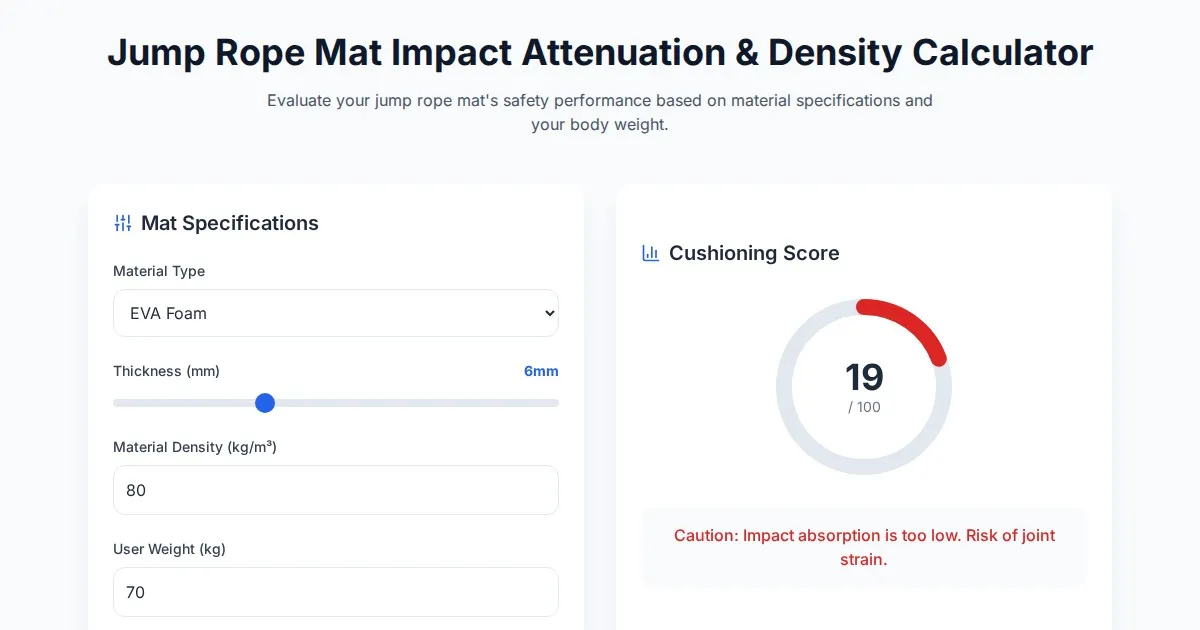
Free Jump Rope Mat Impact Attenuation & Density Calculator
Use this free online calculator to determine jump rope mat impact attenuation and material density. Safely assess if your workout flooring protects your joints.

Free Base64 Image Data URI to File Size Calculator
Accurately calculate the file size of Base64 encoded image data strings. This free, web-based tool helps developers estimate binary file sizes for web apps.

Free Online Color Blindness Simulator & Image Filter Tool
Easily simulate color vision deficiencies like protanopia, deuteranopia, and tritanopia. Upload images to test design accessibility for color blindness.
Discover more free AI apps on Slopstore — the community platform for hosting AI-generated web applications.