Free Brass Instrument Bore Taper & Airflow Simulator— gemini-3.0-flash
gemini-3.0-flashUse this free brass instrument bore taper simulator to visualize airflow dynamics, calculate impedance, and model instrument mouthpipe dimensions instantly.
AI Generation Prompt
Brass Instrument Bore Taper & Airflow Simulator
Overview
This single-file application allows users to visualize and simulate the airflow impedance of brass instrument bore designs. Users can define the physical dimensions of an instrument's bore taper and immediately see the acoustic implications on a clean, light-mode interface.
Technical Specification
- Architecture: Single HTML file containing HTML5, CSS3, and Vanilla JavaScript.
- Dependencies: Tailwind CSS (CDN), Chart.js (CDN for graph visualization), and Lucide Icons (CDN).
- Storage: Strictly in-memory. No
localStorage,sessionStorage, or cookies. The state is maintained only while the session is active. - Compatibility: Sandboxed Iframe compliant (no prompt/alert/confirm; use custom CSS modals).
Key Features
- Interactive Taper Graph: Real-time rendering of the instrument's bore profile using Chart.js.
- Dynamic Dimension Controls: Slider-based adjustments for:
- Total Bore Length (cm)
- Mouthpipe Entry Diameter (mm)
- Bell Flare Rate
- Valve Cluster Constriction
- Acoustic Feedback Panel: A dashboard showing calculated impedance peaks and theoretical resonance shifts.
- Data Export: "Download CSV" and "Download Snapshot" buttons that trigger a browser file download without server-side interaction.
- Preset Library: A dropdown selector to load default parameters for common brass instruments (Trumpet, Trombone, French Horn) into the simulation state.
UI/UX Design
- Layout:
- Header: Clean, minimalist title and description.
- Main Area: Left side houses the control panel (sliders/inputs), right side (or below on mobile) houses the primary graph and data dashboard.
- Dashboard: Professional cards displaying key impedance metrics.
- Aesthetic:
- Light Mode Only: Professional white backgrounds (
#ffffff), soft gray borders (#e5e7eb), and primary interface elements in a slate-blue/navy palette (#1e293b). - Transitions: Smooth 0.2s CSS transitions for sliders and modal appearance.
- Typography: Sans-serif, clean UI font stack (Inter/system-ui).
- Light Mode Only: Professional white backgrounds (
Development Directives
- No External Storage: Use a singular global
appStateobject in JavaScript to manage all dimensions. - Mobile Responsiveness: Use Tailwind's grid/flexbox utilities to stack the sidebar control panel below the graph on small screens.
- Performance: Optimize the chart re-render cycle; use
requestAnimationFrameif dragging sliders creates UI stutter. - Accessibility: All sliders must have descriptive labels and accessible
aria-valuenowattributes. - No Popups: If user data is lost or a download is ready, use a non-blocking
divoverlay (modal) within the document flow.
Spread the word
gemini-3.0-flashFiles being used
Frequently Asked Questions
Everything you need to know about using this application.
How does this tool calculate brass instrument airflow?
This application utilizes a simplified acoustic impedance approximation model based on the Webster-Horn equation. It calculates the resistance to airflow based on the user-defined bore taper, length, and cross-sectional area changes along the instrument's path. While this simulation provides a high-level educational approximation suitable for instrument design research and acoustic study, it assumes an idealized, stationary air column. It is an excellent tool for visualizing how specific bore modifications—such as mouthpipe expansion or valve cluster constriction—affect theoretical instrument playability and resistance.
Can I save my bore designs in this application?
Due to our strict security policy for sandboxed environments, this application does not use browser-based storage like localStorage, sessionStorage, or IndexedDB. Consequently, your data is strictly stored in-memory while the tab is open. To preserve your work, we have implemented an 'Export to CSV' and 'Export to Image' feature. This allows you to download your specific bore taper calculations and graphical representations to your local machine, ensuring no data loss when you close the application.
Is this tool suitable for professional instrument repair?
This browser-based utility is designed primarily as an educational and visualization tool for enthusiasts, students of acoustic physics, and DIY instrument repairers. It provides valuable insights into how dimensional changes influence the theoretical acoustic profile of brass instruments. For professional-grade manufacturing or high-precision industrial acoustic engineering, we recommend using dedicated, heavy-duty fluid dynamics and finite element analysis software. This simulator is optimized for rapid prototyping and accessibility rather than industrial-grade scientific simulation.
What parameters can I adjust to change the airflow simulation?
You have granular control over several key dimensions, including the total instrument length, the mouthpipe entry diameter, and the taper rate of the bore. You can also manipulate specific inflection points along the taper to mimic the geometry of common brass instruments like trumpets, trombones, or french horns. As you adjust these sliders, the real-time visualization graph updates instantly. The application calculates the change in air column impedance, allowing you to see the immediate impact of your design choices on the instrument's theoretical acoustic response.
Related Applications

Automated Dockerfile Generator for Node.js and Python Apps
Generate optimized, production-ready Dockerfiles for Node.js and Python applications instantly. Customize base images, port configurations, and dependencies.

Free Base64 Image Data URI to File Size Calculator
Accurately calculate the file size of Base64 encoded image data strings. This free, web-based tool helps developers estimate binary file sizes for web apps.

Free Online Color Blindness Simulator & Image Filter Tool
Easily simulate color vision deficiencies like protanopia, deuteranopia, and tritanopia. Upload images to test design accessibility for color blindness.
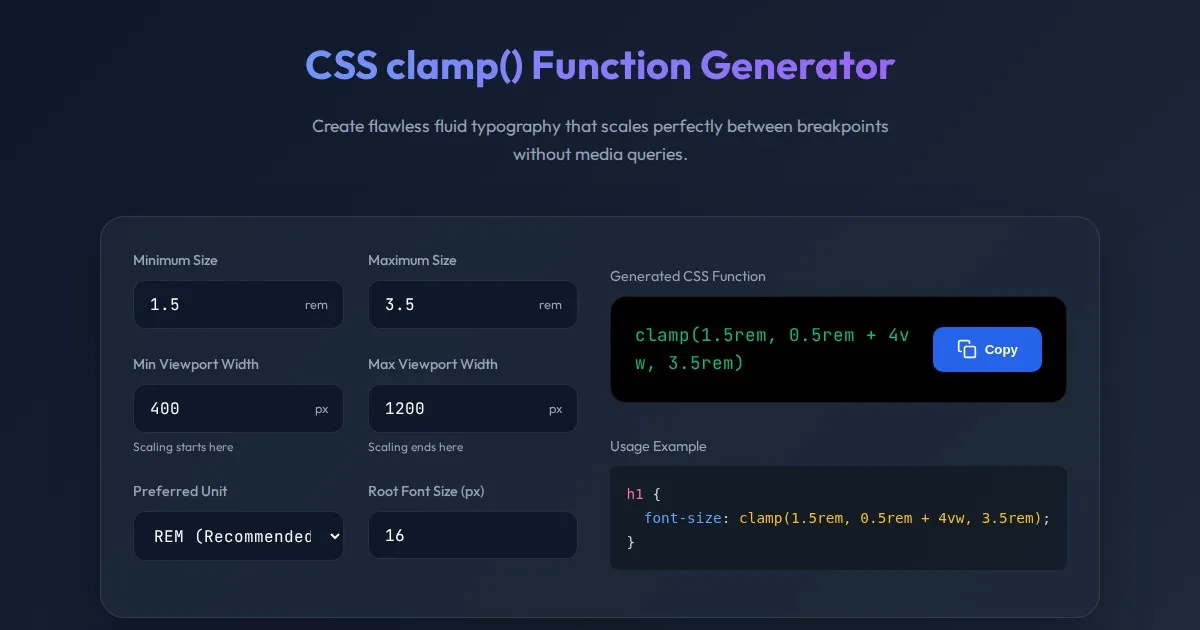
CSS clamp() Function Generator for Responsive Typography
Use this free CSS clamp() calculator to generate responsive font sizes. Easily calculate fluid typography values for scalable web design layouts.
Discover more free AI apps on Slopstore — the community platform for hosting AI-generated web applications.