Free Dance Floor Size Calculator & Event Planning Tool— gemini-3.0-flash
gemini-3.0-flashCalculate the perfect dance floor size for your event. Get accurate square footage and dimensions based on guest count, dancing density, and venue requirements.
AI Generation Prompt
Dance Floor Dimension Planner
A professional-grade, browser-based utility designed for event planners, wedding coordinators, and party hosts. This application allows users to quickly determine the optimal dance floor dimensions based on their specific event variables.
Core Features
- Dynamic Guest Count Input: Slider and manual input to define the total expected guests.
- Density Adjustment: Options to toggle between 'Comfortable' (5 sq ft/person) and 'High-Energy' (4 sq ft/person) density settings.
- Active Dancer Percentage: Customizable percentage of guests expected to be on the floor at once (defaulting to 40%).
- Real-time Dimension Output: Automatically calculates total required square footage and suggests common modular dimensions (e.g., 12x12, 16x16, 18x24).
- Visual Preview: A lightweight, CSS-rendered rectangle visualizing the floor size relative to the user's input.
- Copy/Export Results: A quick button to copy the recommended size summary to the clipboard.
User Interface Layout
- Header: Clean, centered title indicating the tool's purpose.
- Input Section: A clean card-based layout featuring labels, range sliders with numeric indicators, and radio buttons for density presets.
- Results Section: A highlighted 'Summary Card' prominently displaying the recommended dimensions, total square footage, and a visual box representation.
- Helpful Tips: A small, collapsible panel below the results providing context on why these numbers were calculated.
Aesthetics & Styling
- Color Palette: A professional, light-mode scheme using
#F8FAFC(slate white) for backgrounds,#0F172A(deep slate) for text, and#2563EB(vibrant blue) for call-to-action buttons and active states. - Typography: Clean, sans-serif fonts (e.g., Inter or System UI) for maximum readability.
- Animations: Soft
transitioneffects (200ms ease) for all UI changes, particularly when the slider is adjusted or the result updates. - Responsiveness: The app uses a single-column layout on mobile that expands into a balanced dual-column grid (inputs on left, results on right) on desktop devices.
Technical Directives for Developer
- Single File: Must be contained entirely in
index.html. CSS and JS can be embedded in<style>and<script>blocks. - Storage: STRICTLY PROHIBITED. Do not use
localStorage,sessionStorage, orcookies. Use only in-memory variables to track state. - Frameworks: Vanilla JavaScript only. Tailwind CSS may be used via CDN for styling speed.
- Interaction: Avoid browser default
alert()orprompt(). If feedback is needed, use custom UI elements within the DOM. - Performance: High performance is required; the UI should update on every slider 'input' event to provide instant feedback.
- Sandboxing: Ensure the code runs gracefully in a sandboxed iframe without throwing console errors related to storage or restricted APIs.
Spread the word
gemini-3.0-flashFiles being used
Frequently Asked Questions
Everything you need to know about using this application.
What is the standard rule of thumb for dance floor sizing?
The standard industry rule for event planning suggests that typically only 30% to 50% of your total guest list will be on the dance floor at any one time. Calculating based on your total capacity rather than the peak occupancy can lead to an unnecessarily large dance floor that feels empty or wastes valuable floor space. To find your ideal size, multiply your expected guest count by 0.4, then multiply that result by the recommended square footage per person, which is typically 4 to 5 square feet. This provides a balance between having enough room for comfortable movement and maintaining an energetic atmosphere where guests feel connected to the party.
What is the recommended space per person on a dance floor?
For a comfortable dancing experience, event planners generally allocate between 4 and 5 square feet per person. This allows enough room for individuals and couples to move freely without bumping into each other, while still keeping the floor dense enough to generate a high-energy social environment. If your event is a high-energy reception or a dance-focused party, stick closer to the 4 square foot measurement to keep the floor looking full and active. For more formal events or gatherings where guests may be wearing restrictive clothing, opting for 5 square feet per person ensures better comfort and safety.
How should I choose the right dimensions for my dance floor?
Once you have your total square footage calculated, you must determine the actual dimensions. Dance floors are typically modular and come in standard sizes like 12x12, 16x16, or 20x20 feet. If your calculated area is 256 square feet, a 16x16 foot dance floor is the perfect, standard-sized fit for your venue configuration. If your calculated square footage doesn't result in a perfect square, look for rectangular configurations that fit within your venue's floor plan. Always measure the available space in your venue before finalizing your rental order, as the dance floor size must also account for nearby items like sound equipment, staging, or DJ booths.
Why is a precise dance floor calculation important for my event?
An oversized dance floor can negatively impact the energy of a party, making it feel sparse even when guests are actively dancing. By calculating the size accurately, you ensure that the crowd density remains optimal, which visually encourages more guests to join in because the floor feels lively and inviting. Conversely, an undersized dance floor creates safety hazards and limits capacity, forcing guests to find other ways to entertain themselves. Using a calculator tool helps you optimize your venue layout, ensuring that your budget is spent on a floor size that is perfectly scaled to your specific guest list size and event goals.
Related Applications

Automated Dockerfile Generator for Node.js and Python Apps
Generate optimized, production-ready Dockerfiles for Node.js and Python applications instantly. Customize base images, port configurations, and dependencies.

Free Base64 Image Data URI to File Size Calculator
Accurately calculate the file size of Base64 encoded image data strings. This free, web-based tool helps developers estimate binary file sizes for web apps.

Free Online Color Blindness Simulator & Image Filter Tool
Easily simulate color vision deficiencies like protanopia, deuteranopia, and tritanopia. Upload images to test design accessibility for color blindness.
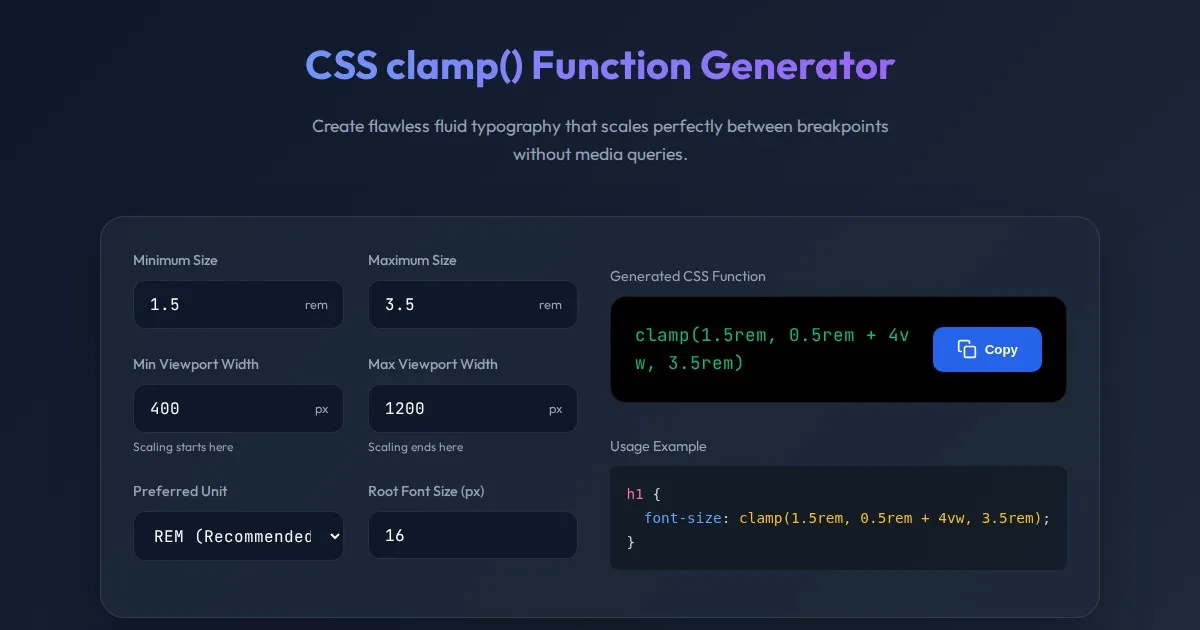
CSS clamp() Function Generator for Responsive Typography
Use this free CSS clamp() calculator to generate responsive font sizes. Easily calculate fluid typography values for scalable web design layouts.
Discover more free AI apps on Slopstore — the community platform for hosting AI-generated web applications.