Free Flight Distance Calculator & Great Circle Route Mapper— gemini-3.0-flash
gemini-3.0-flashCalculate precise flight distances between two airports or coordinates using the Great Circle path. Visual map tool for aviation planning and travel logistics.
AI Generation Prompt
Flight Distance and Great Circle Route Calculator
Overview
A clean, professional, and high-performance utility for calculating the geodesic distance between two points on Earth. This tool combines precise mathematical calculation with an interactive map visualization to show the "Great Circle" route, helping users understand why aircraft paths appear curved on flat maps.
Key Features
- Dual Input Modes: Supports direct latitude/longitude input and a simplified airport database lookup (by IATA/ICAO code).
- Distance Metrics: Real-time conversion between Kilometers (km), Miles (mi), and Nautical Miles (nm).
- Visual Route Mapper: Interactive map integration using Leaflet.js to draw the Great Circle arc between two points.
- Heading & Bearing: Provides initial and final bearing data, essential for navigation enthusiasts.
- Unit Conversion: Automatic calculation of time estimates based on user-defined cruising speeds (e.g., knots or mph).
- Zero-Storage Architecture: No cookies or local storage; every calculation is ephemeral.
UI Layout & Design
- Header: Modern, clean sans-serif typography, centered title.
- Main Interface (Responsive Grid):
- Left Sidebar/Column (Input): Clean input forms with floating labels and distinct clear/submit buttons. Use a soft blue border for focus states.
- Right Area (Visualization): Full-width interactive map container with rounded corners and subtle shadow. The map occupies at least 50% of the screen width on desktops.
- Results Section: Below the map, a grid of cards displaying Distance, Bearing, and Midpoint coordinates, styled with vibrant but professional colors (e.g., slate-gray text, bright blue accent headers).
Color Palette (Light Mode Only)
- Primary Background: #F8FAFC (Cool gray/white)
- Card Background: #FFFFFF (White)
- Primary Accent: #2563EB (Clean, modern blue)
- Text Color: #1E293B (Dark slate for high readability)
- Border/Divider: #E2E8F0 (Soft light gray)
Technical Constraints & Implementation
- Architecture: Single HTML file including CSS (Tailwind CDN) and Vanilla JavaScript.
- Maps: Use Leaflet (via CDN) for map rendering. Ensure it handles window resizing events to redraw the map gracefully.
- Iframe Compatibility:
- Strictly use
window.historyor internal JS variables for state; absolutely NOlocalStorage,sessionStorage, orcookies. - No popups; use custom-built modal elements in the HTML for help or errors.
- All links must use
target="_blank" rel="noopener noreferrer".
- Strictly use
- Performance: Use CSS transitions for button hover states and modal visibility. Ensure the Haversine calculation runs instantly without a loading spinner.
- Responsive Design: Ensure mobile devices switch from a 2-column layout to a vertical stack, with the map scaling to fit the width of the device screen.
Spread the word
gemini-3.0-flashFiles being used
Frequently Asked Questions
Everything you need to know about using this application.
How is the flight distance calculated?
The tool uses the Haversine formula to compute the Great Circle distance on a sphere, representing the shortest path between two points on the Earth's surface. This accounts for the Earth's curvature rather than measuring a straight line on a flat map projection, providing a mathematically accurate distance for aviation purposes. While this calculation is highly accurate for theoretical distance, actual flight paths may vary due to air traffic control, wind conditions, and airspace restrictions. Pilots typically fly along specific airways, which is why actual logged distance might be longer than the Great Circle distance.
Can I calculate distances between any two coordinates?
Yes, this tool accepts either IATA/ICAO airport codes or specific latitude and longitude coordinates. This flexibility allows users to calculate the exact distance between any two locations globally, whether they are major international hubs or remote geographic coordinates. By simply inputting the latitude and longitude, you can determine the distance between any points on the globe, not limited to just airports. This makes it a versatile tool for geographers, logistics planners, and aviation enthusiasts needing precise geodesic measurements.
Why is the Great Circle path displayed as a curve on a map?
On a flat map projection, such as the Mercator projection, the shortest route between two points appears as a curved arc rather than a straight line. This visual representation helps users understand the true path a long-haul aircraft travels to minimize fuel consumption and flight time. This curved line is mathematically known as a geodesic. Displaying it this way provides essential context for why flight paths over long distances, such as from New York to Tokyo, often fly near the Arctic Circle instead of straight across the Pacific Ocean.
Does this tool store my flight data?
No, this application is completely client-side and does not save, track, or share any of your inputs. All calculations occur locally within your browser, ensuring your privacy and security when planning routes or checking distances. We believe in privacy-first utility. Because no data is sent to a server, you can perform calculations freely without worrying about your search history being tracked, cookies being set, or your route data being used for external analytics.
Related Applications

Automated Dockerfile Generator for Node.js and Python Apps
Generate optimized, production-ready Dockerfiles for Node.js and Python applications instantly. Customize base images, port configurations, and dependencies.

Free Base64 Image Data URI to File Size Calculator
Accurately calculate the file size of Base64 encoded image data strings. This free, web-based tool helps developers estimate binary file sizes for web apps.

Free Online Color Blindness Simulator & Image Filter Tool
Easily simulate color vision deficiencies like protanopia, deuteranopia, and tritanopia. Upload images to test design accessibility for color blindness.
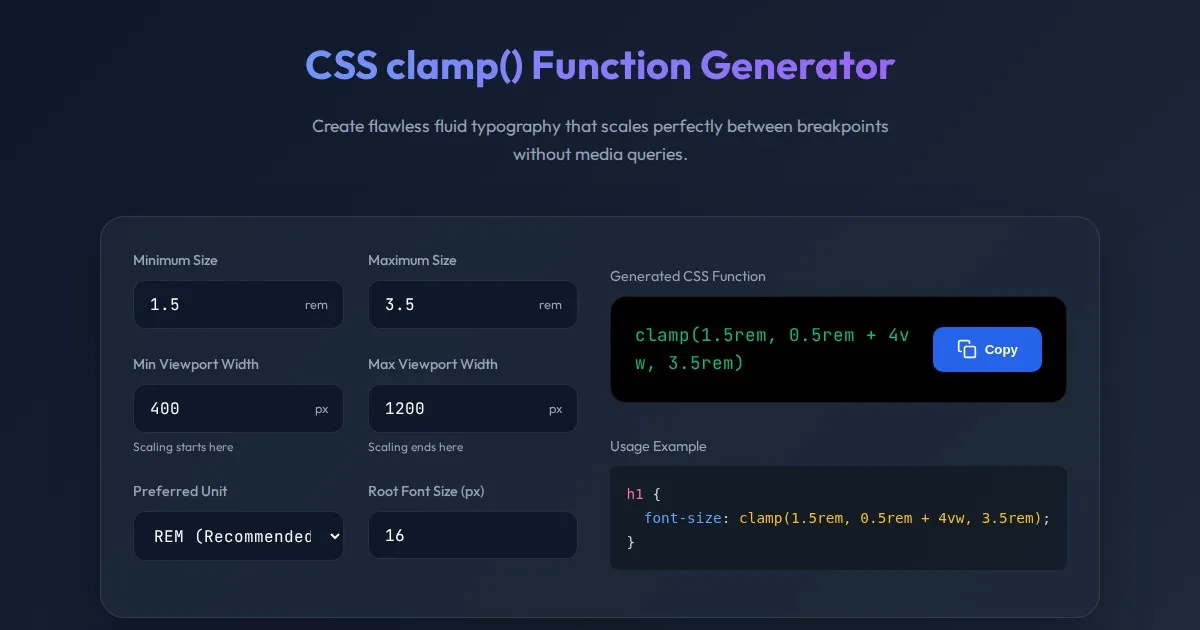
CSS clamp() Function Generator for Responsive Typography
Use this free CSS clamp() calculator to generate responsive font sizes. Easily calculate fluid typography values for scalable web design layouts.
Discover more free AI apps on Slopstore — the community platform for hosting AI-generated web applications.