Free LFO Waveform Visualizer & Audio Synthesis Tool— gemini-3.0-flash
gemini-3.0-flashVisualize synthesizer Low Frequency Oscillator (LFO) waveforms in real-time. Adjust frequency, amplitude, and phase with this free, interactive browser tool.
AI Generation Prompt
Interactive LFO Waveform Visualizer
Overview
A high-performance, browser-based tool designed to help sound designers, music producers, and students visualize Low Frequency Oscillator (LFO) waveforms. The tool provides a real-time oscilloscope-style view of various standard modulation shapes, allowing users to manipulate frequency, amplitude, and phase to understand their behavior.
Core Features
- Waveform Selection: Toggle between Sine, Square, Sawtooth, Triangle, and Sample & Hold wave shapes.
- Real-Time Modulation: Interactive sliders for:
- Frequency: Adjust the oscillation speed (0.1Hz to 20Hz).
- Amplitude: Control the depth of the modulation signal.
- Phase: Shift the starting point of the waveform cycle.
- Canvas Visualization: Smooth, 60fps rendering of the waveform using the HTML5 Canvas API.
- Responsive UI: A clean, sidebar-based control layout that collapses or rearranges for mobile devices.
Technical Implementation
- Architecture: Single HTML file containing HTML5, CSS3, and Vanilla JavaScript.
- Rendering: Uses
requestAnimationFramefor a highly efficient, flicker-free rendering loop. - State Management: All state is handled in-memory using JavaScript objects. No
localStorage,sessionStorage, or cookies are used, ensuring full compliance with sandboxed iframe environments. - Performance: CSS Flexbox/Grid for layout. No heavy external frameworks or build steps required.
User Interface Design
- Palette: Light-mode aesthetic featuring high-contrast grays (
#F8F9FA), soft whites (#FFFFFF), and a vibrant primary action color (e.g., Electric Blue#2563EB) for active controls. - Typography: Clean sans-serif font stack (Inter or System UI) for maximum readability.
- Interaction:
- Subtle hover transitions on all interactive elements.
- Smooth slider movement with value feedback labels.
- A clear, distinct "Reset" button that reverts all parameters to default.
- Layout:
- Header: Simple, descriptive title.
- Main Area: Centered, large canvas container with a soft drop shadow.
- Control Sidebar: Fixed-width container for sliders and waveform selectors.
Constraints & Directives
- No Persistence: Code must not attempt to read/write to browser storage.
- No External Popups: Use CSS-based modal overlays for any "Help" or "About" information.
- Clean Design: Strictly light-mode. No dark mode toggles. The design should feel crisp and modern (SaaS style).
- Accessibility: Ensure high contrast ratios for slider tracks and labels for users with visual impairments.
Spread the word
gemini-3.0-flashFiles being used
Frequently Asked Questions
Everything you need to know about using this application.
What is an LFO in the context of synthesizer sound design?
A Low Frequency Oscillator (LFO) is a signal generator that produces a frequency typically below the audible range (usually below 20Hz). In synthesis, it is used to modulate parameters of a sound source, such as pitch, filter cutoff, or volume, creating periodic movement like vibrato, tremolo, or rhythmic pulsing effects. By visualizing the waveform of the LFO, sound designers can better understand how specific modulation shapes—such as sine, square, or sawtooth waves—will impact the final timbre of a sound. This tool allows users to see exactly how frequency and amplitude settings change the movement pattern of the oscillator in real-time.
Does this tool save my waveform settings for later use?
No, this application is designed as a stateless, ephemeral tool. To comply with strict security standards and protect user privacy, it does not use cookies, localStorage, or any other form of persistent data storage to save your settings or waveform configurations. Every time you refresh the page, the application returns to its default state. This ensures that the tool is lightweight, fast, and secure, making it ideal for quick visualizations without the need for an account or data tracking.
How does the waveform visualization work in the browser?
This application utilizes the HTML5 Canvas API to render real-time animations based on mathematical oscillation functions. When you adjust the frequency or phase controls, the underlying JavaScript calculates the coordinate points for the waveform and redraws the path on the canvas at 60 frames per second. This approach ensures smooth, high-fidelity visualization that reacts instantly to your inputs. By calculating the path mathematically rather than using pre-recorded video, the visualizer remains accurate across all zoom levels and device screen sizes.
Is this tool compatible with mobile devices and tablets?
Yes, the application is built with a responsive-first design philosophy. The layout automatically adapts to different screen sizes, ensuring that the control panel and the canvas area remain accessible and legible on mobile phones, tablets, and desktop computers alike. Touch interactions are fully supported, allowing you to manipulate sliders and toggles with your fingers. The visualization canvas uses CSS scaling to fill available space, providing a high-quality experience regardless of the device you are using to access the tool.
Related Applications
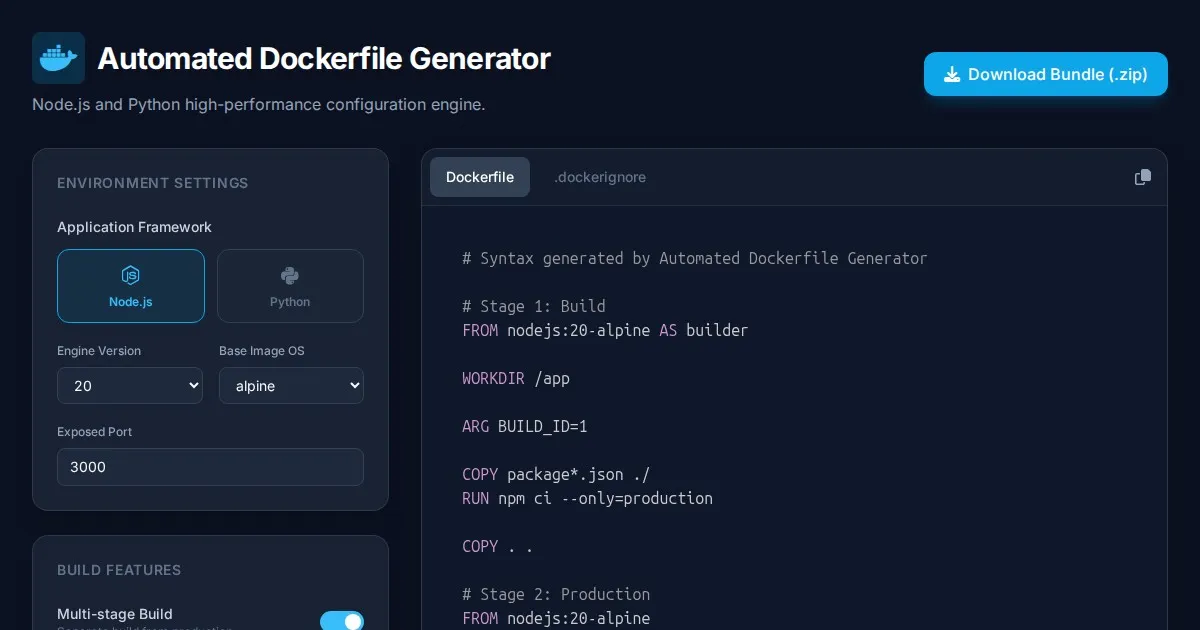
Automated Dockerfile Generator for Node.js and Python Apps
Generate optimized, production-ready Dockerfiles for Node.js and Python applications instantly. Customize base images, port configurations, and dependencies.
Free Base64 Image Data URI to File Size Calculator
Accurately calculate the file size of Base64 encoded image data strings. This free, web-based tool helps developers estimate binary file sizes for web apps.
Free Online 3D Model Viewer - GLTF & OBJ File Previewer
Instantly preview 3D models online with this free 3D Model Viewer. Support for GLTF, GLB, and OBJ formats. Drag and drop your files for a fast, browser-based render.
Free Online Color Blindness Simulator & Image Filter Tool
Easily simulate color vision deficiencies like protanopia, deuteranopia, and tritanopia. Upload images to test design accessibility for color blindness.
Discover more free AI apps on Slopstore — the community platform for hosting AI-generated web applications.