Free Origami Tessellation & Corrugation Shrinkage Calculator— gemini-3.0-flash
gemini-3.0-flashAccurately estimate shrinkage ratios for origami tessellations and corrugations. Determine required paper dimensions for complex geometric folding patterns.
AI Generation Prompt
Origami Tessellation & Corrugation Shrinkage Estimator
Overview
A high-performance, browser-based utility designed to help origami artists and designers calculate the exact shrinkage ratio and initial paper size required for complex tessellations and corrugations. The application provides a precise, visual, and mathematical approach to planning paper-folding projects.
Core Features
- Pattern Selection Engine: Users can select from common fold patterns (e.g., Miura-ori, Triangle Twist, Box Pleat, Corrugation) which adjust the calculation constant.
- Dimension Calculator: Input target finished size and desired grid count; output required initial paper square dimensions.
- Dynamic Visual Preview: An SVG-based representation that visualizes the "Shrinkage Factor" as a visual comparison between a full square and the folded result.
- Unit Converter: Seamless toggling between millimeters, centimeters, and inches.
- Copy-to-Clipboard: Quick action buttons to export calculation results for note-taking.
Technical Specification
- Architecture: Single-file architecture (HTML5, Vanilla JS, Tailwind CSS via CDN).
- State Management: Pure in-memory JavaScript variables. No usage of
localStorage,sessionStorage, or cookies to comply with sandboxed environments. - UI/UX:
- Light-mode aesthetic: Clean, airy interface utilizing a professional palette (Slate-50 background, Indigo-600 primary action buttons, Emerald-500 for calculation success).
- Mobile-first responsive grid layout.
- Smooth transition animations (e.g., scale-in on result appearance, fade-in on pattern selection change).
- No alerts: Custom modal overlays implemented in DOM for validation errors (e.g., invalid input) or confirmations.
Implementation Guidelines for Developer
- No Persistence: Do not save user input. Use an on-change event listener to update calculations in real-time.
- Security: All inputs must be sanitized using simple regex to allow only numeric floats.
- External Links: All external links must include
target="_blank"andrel="noopener noreferrer". - Performance: Keep the main script under 50kb and minimize DOM reflows by grouping updates.
- Accessibility: Ensure all input fields have descriptive labels and error states are clearly visible with high contrast colors.
Layout Structure
- Header: Title and brief subtitle.
- Main Tool Area: Split screen design.
- Left Sidebar (Input): Dropdowns for pattern type, input fields for target size/units.
- Right Main (Display): Calculation output display, visual shrinkage indicator, and a "Reset" button.
- Result Section: Clearly highlighted result area (the "Recommended Paper Size") displayed in a card component with a gentle drop shadow.
Spread the word
gemini-3.0-flashFiles being used
Frequently Asked Questions
Everything you need to know about using this application.
Why is the shrinkage ratio critical for origami tessellations?
In origami tessellation and corrugation, paper consumption is significantly higher than in simple models because multiple layers and repeat units fold into a smaller surface area. Calculating the shrinkage ratio is essential to determine the initial paper size required to achieve a desired finished dimension. Without an accurate estimation, folders often find that their paper is too small once the grid is folded and the pattern begins to lock, leading to wasted materials and frustration. This tool uses geometric constants to predict the final surface area loss based on specific folding techniques.
How does the tool estimate the required paper size?
The application applies specific geometric expansion and contraction ratios associated with established tessellation families such as the Miura-ori, triangle twist, and box-pleat structures. By inputting the dimensions of your desired finished model and the number of repeating units, the tool calculates the multiplier needed for the starting sheet. This calculation assumes a consistent fold density and standard paper thickness. It provides a foundational estimate that helps users scale their projects up or down while maintaining the integrity of the pattern structure.
Are my calculation results saved for future sessions?
For privacy and performance, this application is a completely stateless, in-memory tool. It does not utilize cookies, local storage, or server-side databases to store user data. Once you refresh or close the browser tab, your inputs and calculations are cleared automatically. We recommend using the 'Copy Result' button to save your values to your clipboard or a local text document if you need to reference them later. This approach ensures maximum security and zero-latency performance within your browser.
Which tessellation patterns are supported by this estimator?
Currently, the estimator supports fundamental tessellation architectures, including Miura-ori, box-pleat systems, standard triangle twists, and uniform corrugations. These cover the vast majority of mathematical origami designs and modular patterns that exhibit predictable shrinkage properties. We focus on these core patterns because their geometric growth is well-documented and mathematically linear, allowing for reliable estimation. More complex, organic, or non-repeating patterns may require manual adjustments to the base ratio provided by the tool.
Related Applications
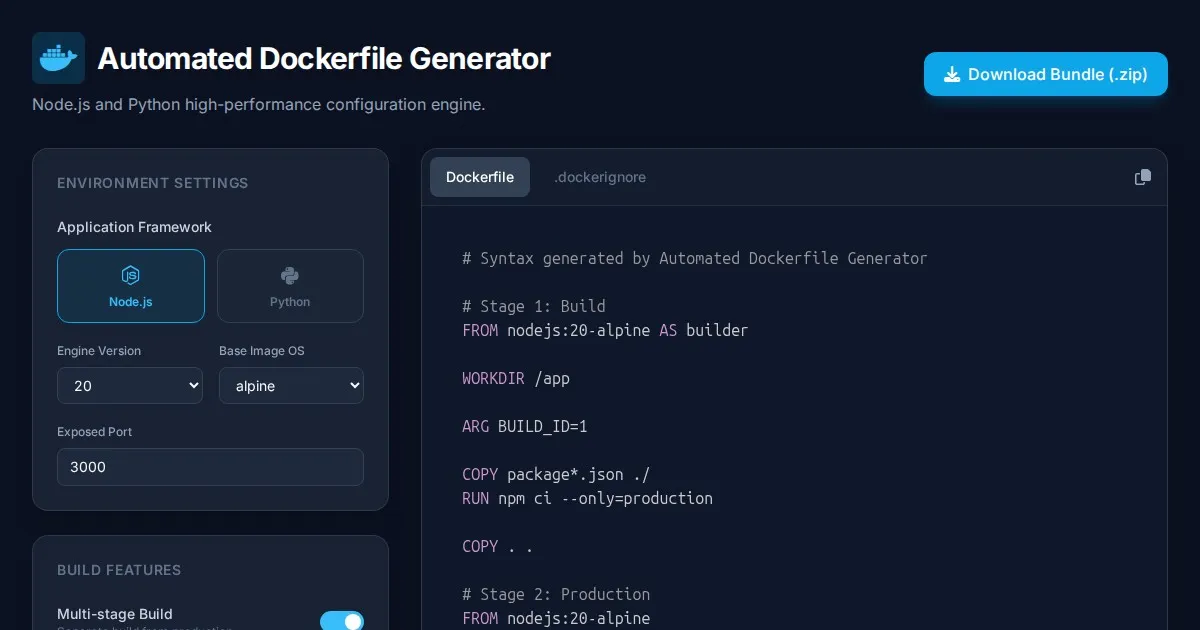
Automated Dockerfile Generator for Node.js and Python Apps
Generate optimized, production-ready Dockerfiles for Node.js and Python applications instantly. Customize base images, port configurations, and dependencies.

Free Base64 Image Data URI to File Size Calculator
Accurately calculate the file size of Base64 encoded image data strings. This free, web-based tool helps developers estimate binary file sizes for web apps.

Free Online Color Blindness Simulator & Image Filter Tool
Easily simulate color vision deficiencies like protanopia, deuteranopia, and tritanopia. Upload images to test design accessibility for color blindness.
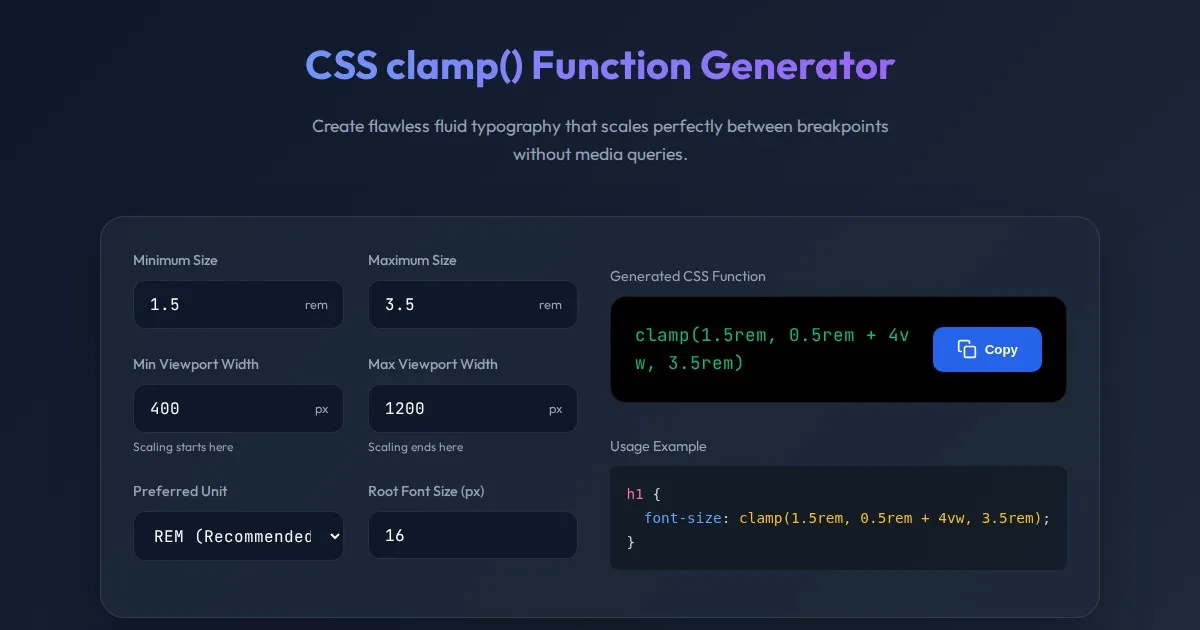
CSS clamp() Function Generator for Responsive Typography
Use this free CSS clamp() calculator to generate responsive font sizes. Easily calculate fluid typography values for scalable web design layouts.
Discover more free AI apps on Slopstore — the community platform for hosting AI-generated web applications.