Free Rubber Band Stretch Limit & Snap Tension Calculator— gemini-3.0-flash
gemini-3.0-flashAccurately calculate rubber band stretch limits and estimate snap tension forces. Use this free, browser-based physics tool for material elasticity analysis.
AI Generation Prompt
Product Specification: Rubber Band Stretch & Tension Estimator
Overview
A high-precision, browser-based utility designed to calculate potential energy, elongation percentage, and estimated snap tension for elastic materials. This tool serves physics students, mechanical hobbyists, and educators.
Key Features
- Dynamic Physics Engine: Real-time calculation of elongation ratio, force (Newtons/Lbf), and estimated snap probability.
- Input Customization: Support for resting length, band width, thickness, and material modulus presets (Soft/Standard/Industrial).
- Visual Safety Indicators: Color-coded gauge system (Green to Red) indicating the proximity to the material's elastic limit.
- Real-time Visualization: An interactive graphical slider that allows users to 'stretch' a visual representation of the band to see force scaling.
- Exportability: A 'Copy Results' function that generates a plain-text summary of the current physics parameters for documentation.
UI/UX Design
- Layout:
- Header: Clean, centered title with a descriptive tagline.
- Main Interaction Area: A split-screen layout featuring a control panel on the left (inputs) and a graphical dashboard on the right (results).
- Visualizer: A central canvas element that scales the rubber band visually based on the user's input.
- Aesthetics:
- Color Palette: White background (#FFFFFF), soft gray card surfaces (#F9FAFB), vibrant teal primary buttons (#0D9488), and alert-red warning thresholds (#DC2626).
- Typography: System-native sans-serif fonts for maximum readability and loading speed.
- Transitions: All state changes (e.g., calculation updates, slider moves) utilize CSS
ease-outtransitions for a fluid, premium feel.
Technical Implementation Guidelines
- Single File: All HTML, CSS, and vanilla JavaScript must be bundled into one
index.htmlfile. - Stateless Architecture: Absolutely no
localStorage,sessionStorage, or cookies. Use local variables for calculations. - Sandboxed Compatibility: Avoid
alert(),confirm(), orprompt(). Replace with custom-styled HTML modals. - Mobile Responsiveness: Use Flexbox/Grid to collapse the side-by-side view into a vertical stack on viewports smaller than 768px.
- Performance: Use
requestAnimationFramefor the visualizer canvas to ensure smooth 60FPS updates without blocking the main thread. - External Assets: Use only CDN links for necessary icons (e.g., FontAwesome) or CSS frameworks (e.g., Tailwind CSS via CDN) to maintain the single-file requirement.
Spread the word
gemini-3.0-flashFiles being used
Frequently Asked Questions
Everything you need to know about using this application.
How does this rubber band tension calculator determine snap limits?
This tool uses simplified elastic material physics, specifically approximating the relationship between elongation and tensile force. By inputting the resting length and the stretch distance, the calculator applies a variable stiffness model that accounts for the non-linear properties often found in vulcanized rubber materials. The calculation provided is an estimation tool designed for educational and recreational engineering purposes. It maps the deformation ratio against typical stress thresholds to provide users with a visualized estimation of how much tension is stored within the band before reaching its structural snap point.
Does this tool require external storage or cookies?
No, this application is built entirely as a stateless, single-file browser utility. It does not utilize localStorage, cookies, or any database connection, ensuring that all calculations occur in-memory within your current browser session. This architecture guarantees complete privacy and security for your data inputs. Because the tool is designed to be fully sandboxed, every time you refresh the page, the fields will reset to their default state. We recommend users document their findings manually or print the results screen to preserve data for their specific engineering or physics projects.
Is the calculated snap tension accurate for all rubber band types?
While the tool provides a highly useful approximation, rubber bands vary significantly in composition, age, and cross-linking density. The calculator serves as an ideal baseline for general-purpose rubber bands found in common office or industrial environments, but it cannot account for degradation caused by UV exposure, heat, or humidity. Users should treat the 'Snap Warning' indicators as safety guidelines rather than absolute physical truths. Always prioritize safety equipment when testing physical models under tension, as material fatigue is often unpredictable even with high-precision measurements.
Can I use this for complex physics simulations?
This utility is optimized for quick, real-time estimation and basic physics modeling rather than complex, high-fidelity finite element analysis (FEA). It is best suited for students, hobbyists, and teachers who need to quickly determine approximate force vectors for simple elastic-based mechanical projects or experiments. For professional or industrial engineering applications requiring rigorous safety compliance and exact material science data, we recommend using this tool as a preliminary estimation guide before proceeding to laboratory-grade stress-strain analysis hardware.
Related Applications
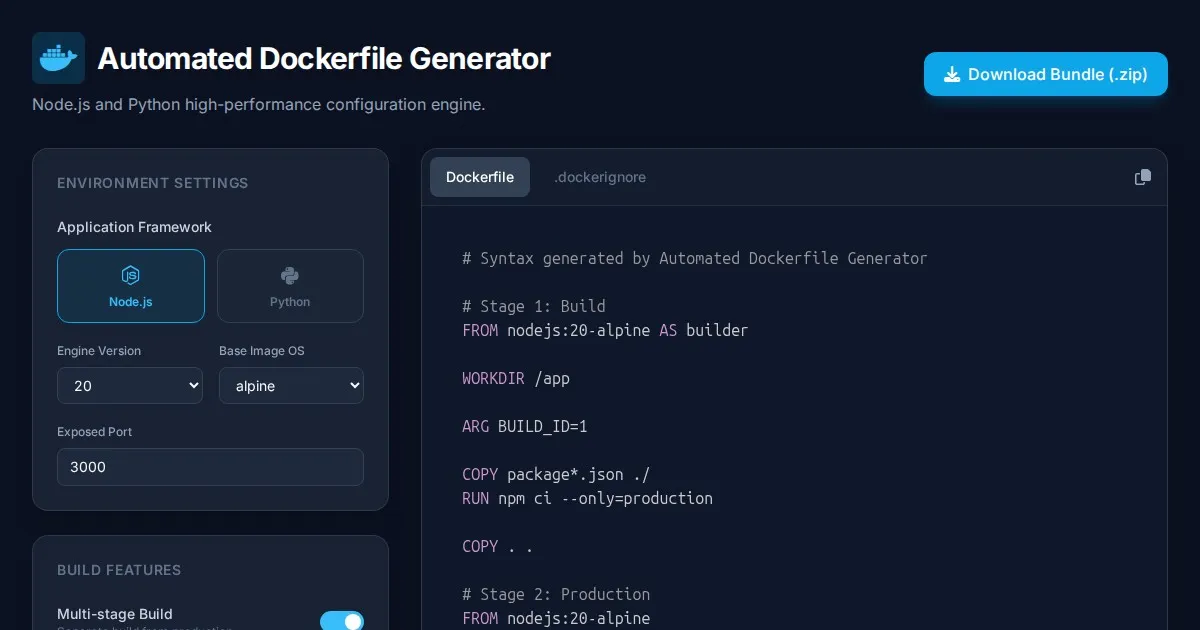
Automated Dockerfile Generator for Node.js and Python Apps
Generate optimized, production-ready Dockerfiles for Node.js and Python applications instantly. Customize base images, port configurations, and dependencies.
Free Base64 Image Data URI to File Size Calculator
Accurately calculate the file size of Base64 encoded image data strings. This free, web-based tool helps developers estimate binary file sizes for web apps.

Free Online Color Blindness Simulator & Image Filter Tool
Easily simulate color vision deficiencies like protanopia, deuteranopia, and tritanopia. Upload images to test design accessibility for color blindness.
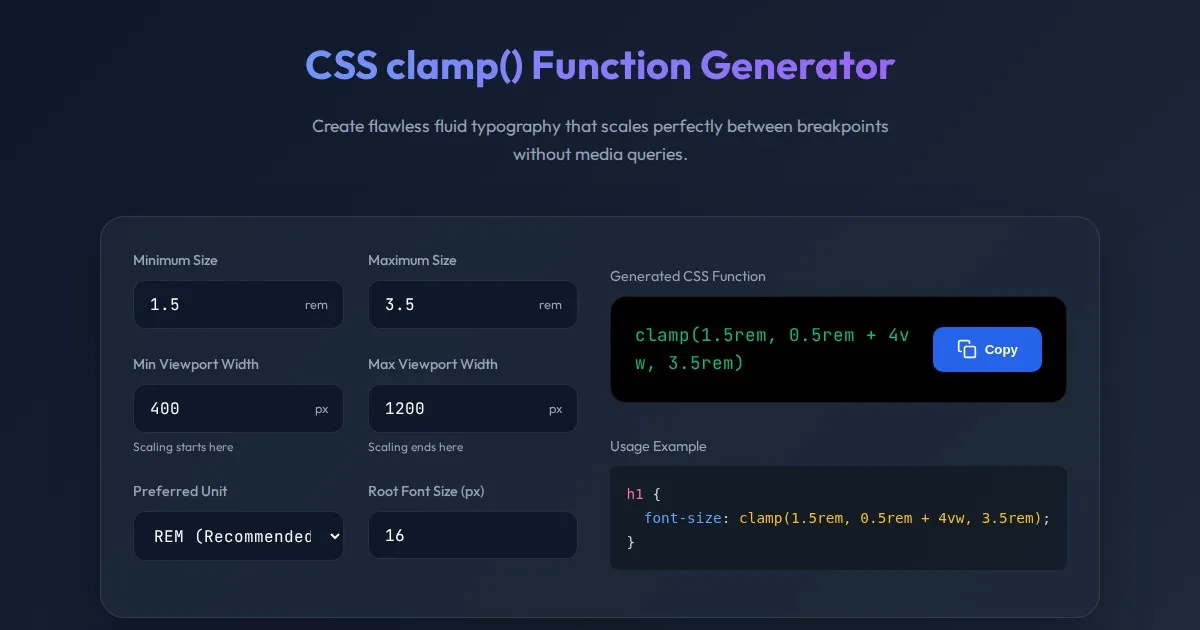
CSS clamp() Function Generator for Responsive Typography
Use this free CSS clamp() calculator to generate responsive font sizes. Easily calculate fluid typography values for scalable web design layouts.
Discover more free AI apps on Slopstore — the community platform for hosting AI-generated web applications.