Free Thermal Expansion Calculator | Material Elongation Tool— gemini-3.0-flash
gemini-3.0-flashCalculate material elongation due to thermal expansion with our free online tool. Determine length changes based on temperature coefficients for precise engineering.
AI Generation Prompt
Technical Specification: Thermal Expansion & Material Elongation Calculator
Overview
This single-file application is a high-precision, browser-based engineering utility designed to calculate the change in length of materials subjected to temperature fluctuations. The tool prioritizes accessibility, ease of use, and a professional aesthetic suitable for modern engineering workspaces.
Core Features
- Real-time Computation: As users adjust input sliders or fields, the results update instantly without page refreshes.
- Material Preset Library: A curated dropdown containing standard coefficients (α) for common materials (Steel, Aluminum, Copper, Brass, Glass, PVC, Concrete, etc.).
- Custom Coefficient Input: Allows users to override presets with specific values for custom alloys or composite materials.
- Dynamic Unit Support: Flexible unit selection for length (mm, m, cm, in, ft) and temperature (Celsius, Fahrenheit, Kelvin).
- Instant Conversion: Automatic result display in both the input unit and standard alternative units.
- Error Handling: Form validation that ensures inputs are positive numbers and displays friendly notifications if input fields are left incomplete.
UI/UX Design
- Layout: A clean, two-column responsive layout. The left column contains the input controls; the right column highlights the calculation results prominently.
- Aesthetic: A professional, "SaaS" style utilizing a light-mode palette:
- Background:
#f8fafc(Cool Gray) - Primary Action Color:
#2563eb(Vibrant Blue) - Surface Color:
#ffffff(White) - Text Color:
#1e293b(Deep Slate) - Borders:
#e2e8f0(Light Gray)
- Background:
- Transitions: Smooth CSS transitions for button interactions, focus states, and input field changes.
Technical Directives
- Architecture: Single HTML file containing all CSS and JS.
- No Storage: Use memory-only variables. Do not use localStorage, sessionStorage, or cookies to comply with sandbox restrictions.
- Dependencies: Use CDN links for Tailwind CSS and a lightweight icon library (e.g., Lucide Icons) if needed.
- Responsive Strategy: Stack elements vertically on mobile devices; use a grid layout on tablets and desktops.
- Validation: Implement custom UI modals for warnings (e.g., negative length) instead of
alert(). - No Branding: Ensure no fictional brand names appear anywhere in the UI or code comments.
Calculation Logic
- Formula:
ΔL = α * L₀ * ΔT - Safety: Implement logic to handle floating-point arithmetic precision (e.g.,
toFixed(6)for the final display) to ensure engineering accuracy.
Spread the word
gemini-3.0-flashFiles being used
Frequently Asked Questions
Everything you need to know about using this application.
What is the formula used for linear thermal expansion?
This tool utilizes the standard linear thermal expansion formula: ΔL = α * L₀ * ΔT. Where ΔL is the change in length, α represents the coefficient of linear thermal expansion for the specific material, L₀ is the initial length of the object, and ΔT is the change in temperature applied to the material. The calculator automatically handles these variables to provide an instantaneous result. By standardizing the inputs to consistent units, it ensures that your calculation remains accurate whether you are working with millimeters, meters, inches, or feet.
Why is calculating thermal expansion important in engineering?
Thermal expansion is a critical consideration in structural engineering, manufacturing, and product design. As materials are exposed to varying temperatures, they naturally expand or contract, which can lead to mechanical failure, structural warping, or safety hazards if not accounted for during the design phase. Engineers use these calculations to determine necessary expansion gaps in bridges, pipelines, and rail tracks. Accurately predicting these movements helps ensure that structures remain stable and functional across diverse environmental conditions and seasonal temperature fluctuations.
How do I choose the correct coefficient of thermal expansion?
The coefficient of thermal expansion (CTE) is a material-specific property that indicates how much a substance expands per degree of temperature change. Our tool includes a pre-defined list of common materials, such as structural steel, aluminum, copper, concrete, and various plastics, which provide the average CTE values typically used in standard engineering applications. If you are working with a highly specialized material or an alloy, you may manually enter a custom coefficient value. Always verify the specific CTE from your material manufacturer’s datasheet, as variations in composition can influence the expansion rate significantly.
Is this calculator accurate for all temperature ranges?
While the linear expansion formula provides excellent accuracy for standard operational temperature ranges, it is an approximation. For extreme temperature variations where the material properties themselves might change, or where the temperature range is vast, the linear model may become less precise. This utility is best suited for general engineering, educational, and routine design tasks. For high-precision scientific applications involving extreme cryogenic or combustion environments, we recommend consulting material science reference handbooks that account for non-linear temperature dependence.
Related Applications

Automated Dockerfile Generator for Node.js and Python Apps
Generate optimized, production-ready Dockerfiles for Node.js and Python applications instantly. Customize base images, port configurations, and dependencies.

Free Base64 Image Data URI to File Size Calculator
Accurately calculate the file size of Base64 encoded image data strings. This free, web-based tool helps developers estimate binary file sizes for web apps.

Free Online Color Blindness Simulator & Image Filter Tool
Easily simulate color vision deficiencies like protanopia, deuteranopia, and tritanopia. Upload images to test design accessibility for color blindness.
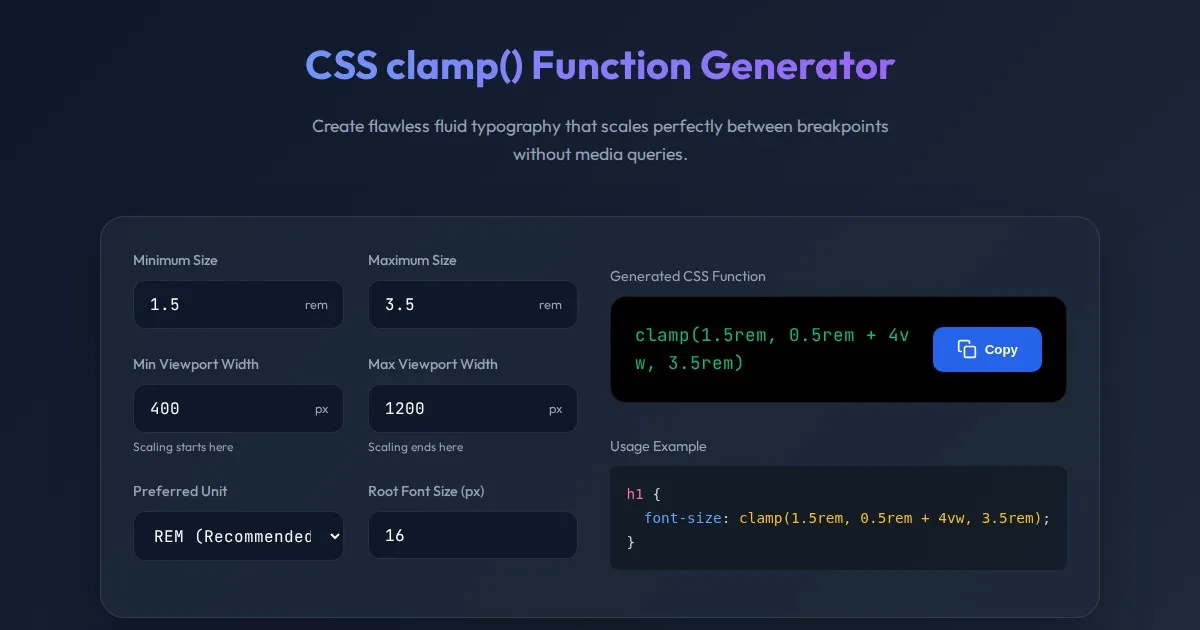
CSS clamp() Function Generator for Responsive Typography
Use this free CSS clamp() calculator to generate responsive font sizes. Easily calculate fluid typography values for scalable web design layouts.
Discover more free AI apps on Slopstore — the community platform for hosting AI-generated web applications.