Kepler's Laws of Planetary Motion Visualizer & Simulator— gemini-3.0-flash
gemini-3.0-flashExplore celestial mechanics with this free, interactive Kepler's Laws of Planetary Motion visualizer. Simulate elliptical orbits, areas, and orbital periods.
AI Generation Prompt
Kepler's Laws of Planetary Motion Visualizer
Overview
A high-fidelity, educational web application designed to visualize and calculate the motion of celestial bodies according to Kepler’s Laws. This tool provides an interactive canvas where users can manipulate orbital parameters to see immediate effects on planetary movement.
Core Features
- Interactive Orbit Canvas: A central HTML5 Canvas area rendering the elliptical orbit of a planet around a central star (Sun).
- Parameter Controls: Sliders to adjust:
- Eccentricity (0 to 0.9): Flatten the orbit visually.
- Semi-major Axis: Scale the size of the orbit.
- Simulation Speed: Control the playback speed of the animation.
- Keplerian Overlays:
- Swept Area Visualization: A toggle to show segments of the orbit that represent equal areas swept in equal time (demonstrating Law 2).
- Focus Points: Display the focus points of the ellipse.
- Real-time Data Display: Live updates for orbital period, current velocity, and instantaneous distance from the star.
- Animation System: Smooth
requestAnimationFrameloop that ensures high-performance, frame-rate independent physics simulation.
Technical Specification
- Architecture: Single-file HTML/JS/CSS. All logic encapsulated in a single file.
- No Storage Constraint: State management is held entirely in JavaScript objects. No cookies,
localStorage, or database interactions. - Responsive Design: The canvas will dynamically scale to fit the viewport width, maintaining aspect ratio. The control panel will stack vertically on mobile and sit to the side on desktop.
- Performance: Use Canvas API for rendering (avoiding heavy DOM elements for the animation).
UI/UX Design
- Color Palette (Light Mode Only):
- Background:
#FFFFFF(White) - Panel Background:
#F8FAFC(Slate 50) - Border/Accents:
#E2E8F0(Slate 200) - Primary Brand/Action Color:
#3B82F6(Blue 500) - Text:
#1E293B(Slate 800)
- Background:
- Aesthetic Guidelines:
- Use soft, subtle
box-shadowfor the control panel card. - Sans-serif typography (system-ui) for legibility.
- Smooth CSS transitions (
transition: all 0.2s ease) for UI element interactions. - No alerts: Use custom, clean modal popups if information or error messages are required.
- Use soft, subtle
Development Directives
- Vanilla JS Only: No frameworks (React, Vue, Angular). Pure JavaScript.
- Sandboxed Compatibility: Ensure no code attempts to access persistent storage or window openers.
- External Resources: Only use approved CDNs (e.g., Tailwind CSS, Google Fonts via link/script tags).
- Performance: Ensure the simulation loop is throttled to 60fps to prevent CPU spikes.
Spread the word
gemini-3.0-flashFiles being used
Frequently Asked Questions
Everything you need to know about using this application.
What are Kepler's three laws of planetary motion?
Kepler's laws are three scientific laws describing the motion of planets around the Sun. The first law states that the orbit of a planet is an ellipse with the Sun at one of the two foci. The second law states that a line segment joining a planet and the Sun sweeps out equal areas during equal intervals of time, meaning planets move faster when closer to the Sun. The third law, also known as the law of harmonies, states that the square of a planet's orbital period is directly proportional to the cube of the semi-major axis of its orbit. Together, these laws provide a fundamental understanding of celestial mechanics and gravity.
How can I use this simulator to learn about orbital mechanics?
This tool provides an interactive environment where you can manipulate orbital parameters like eccentricity and the semi-major axis in real-time. By observing the visual representation, you can see how increasing eccentricity flattens the orbit and how changes in distance affect the orbital velocity of the planet. Use the playback controls to observe the 'swept area' feature, which visually demonstrates Kepler's second law by shading the area covered by the planet's trajectory over specific time intervals. This helps translate abstract mathematical formulas into intuitive, visual knowledge.
Is this tool compatible with mobile devices?
Yes, this Kepler's Laws visualizer is fully responsive and optimized for a wide range of devices, including smartphones, tablets, and desktop computers. The interface adjusts dynamically to your screen size to ensure the canvas simulation remains clear and functional. We have designed the UI to use touch-friendly sliders and buttons, making it easy to adjust orbital variables while on the go. Whether you are using a mouse or a touchscreen, the simulation remains fluid and responsive.
Does this application save my data or settings?
This application operates entirely within your browser's memory. It does not use cookies, local storage, or server-side databases to save any user preferences or session data. Once you refresh the page or close your browser tab, the application resets to its default state. This architecture ensures complete privacy and security, as no information is ever stored or transmitted to external servers. It is built specifically as a stateless utility tool for immediate educational use.
Related Applications
Free Base64 Image Data URI to File Size Calculator
Accurately calculate the file size of Base64 encoded image data strings. This free, web-based tool helps developers estimate binary file sizes for web apps.
Free Online 3D Model Viewer - GLTF & OBJ File Previewer
Instantly preview 3D models online with this free 3D Model Viewer. Support for GLTF, GLB, and OBJ formats. Drag and drop your files for a fast, browser-based render.
Free Online Color Blindness Simulator & Image Filter Tool
Easily simulate color vision deficiencies like protanopia, deuteranopia, and tritanopia. Upload images to test design accessibility for color blindness.
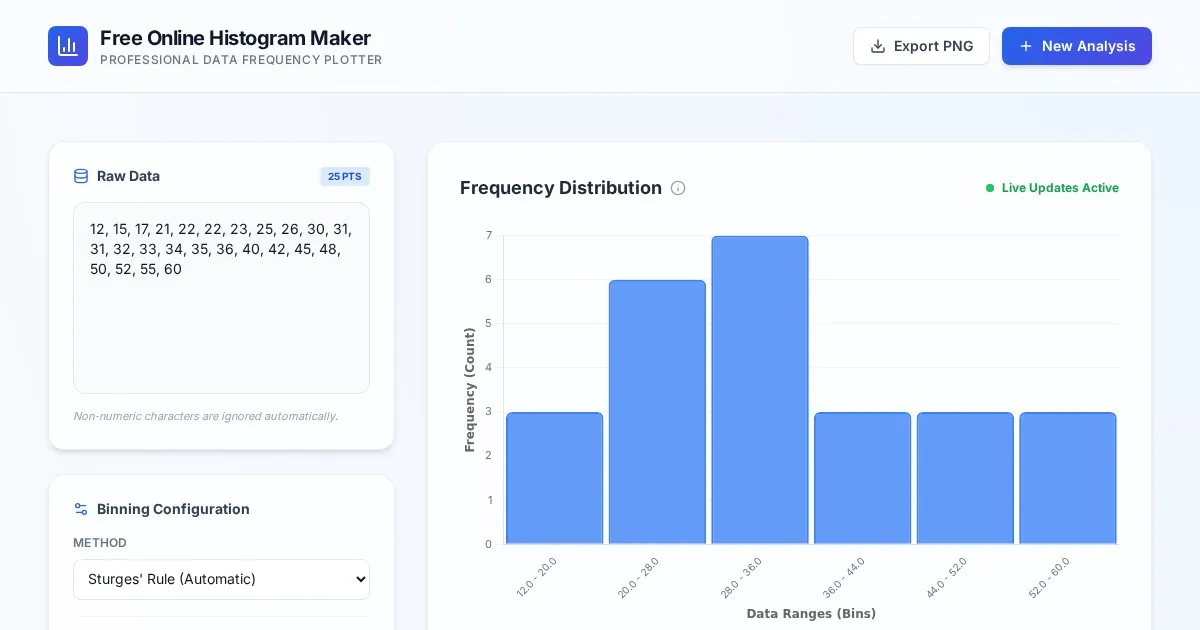
Free Online Histogram Maker & Data Frequency Plotter
Easily create professional histograms from your numeric data. Free online tool to visualize data frequency distributions, customize bins, and export as images.
Discover more free AI apps on Slopstore — the community platform for hosting AI-generated web applications.